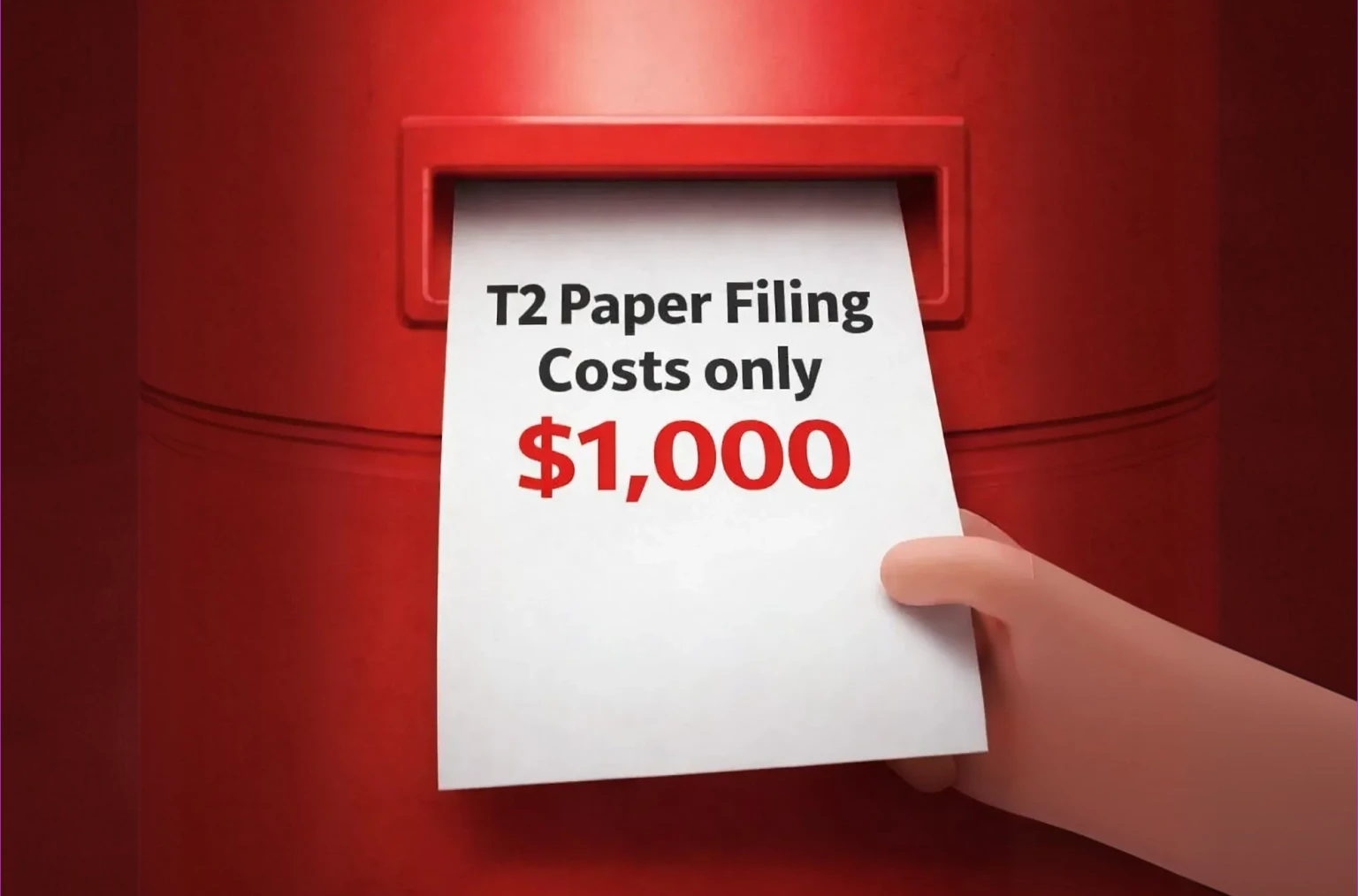

A few days ago, I saw a Reddit post from someone who had just received their Notice of Assessment from the CRA.
They were surprised to see a $1,000 penalty for non-compliance.
They explained that they had filed their T2 return on paper. They did not realize that mandatory electronic filing applies to most corporations after 2023. This was their final return before dissolution. The business was small, with around $12,000 in revenue and a net loss.
Paper filing felt like the easiest option. The business was already closed, and T2 software felt unnecessary for such a simple situation.
They later noticed the assessment showed “proposed changes” and submitted a penalty relief request. The CRA approved it, and the penalty was removed.
The issue was not unpaid tax. It was using a filing method that no longer meets CRA requirements.
Why Paper Filing Felt Like the Right Choice
Reading the post, one thing became clear.
The person did not file on paper out of ignorance. They filed on paper because the alternatives felt worse.
Most T2 filing software in the market is built with accountants in mind. Dense interfaces. Technical language. Screens that assume you understand schedules before you even know if you need them.
For a small or inactive corporation, that experience can feel overwhelming.
So the logic was simple.
Paper is slow, but familiar.
Paper is basic, but understandable.
If the business is small and inactive, why fight with software that feels designed for large corporations?
That logic used to work.
It does not anymore.
The pWhat Quietly Changed With the CRA
For tax years ending after 2023, the CRA expanded mandatory electronic filing requirements for T2 returns.
Most corporations are now expected to file electronically, regardless of:
- Revenue size
- Tax payable
- Activity level
- Whether it is a final return
If a corporation files on paper when electronic filing is required, the CRA can apply a $1,000 penalty.
This penalty is not about tax owing.
It is not about mistakes in numbers.
It is about how the return reaches the CRA.
That is why the Reddit post felt so relatable. The person did not fail at tax. They failed at keeping up with a procedural change that was never loudly announced.
Why There Was No Warning
One question appeared repeatedly in the comments.
Why did the CRA not warn them?
The answer is frustrating but consistent with how the CRA operates.
There is no reminder letter.
There is no grace notice.
The expectation is that corporations stay current with filing rules. If the return arrives in a format that no longer meets requirements, the penalty appears on the Notice of Assessment.
For many small business owners, that Notice is the first time they learn that paper filing is no longer acceptable.
Sometimes the Penalty Gets Reversed
In the Reddit thread, the story had an ending many people hope for.
The person submitted a penalty relief request. They explained that the corporation had minimal revenue, reported a loss, and that this was the final return before dissolution.
The CRA accepted the explanation. The penalty was reversed.
But reading through the replies, one thing stood out.
This outcome was not guaranteed.
Several commenters shared similar stories where relief was denied. Others mentioned long wait times, multiple calls, and uncertainty about the final decision.
Relief is discretionary. It depends on circumstances, compliance history, and how the request is reviewed.
The real problem is not the penalty itself. It is that small corporations are being pushed into these situations because the tools they need feel inaccessible.
Where the Real Friction Comes From
The Reddit post revealed something deeper than a filing mistake.
The real issue was usability.
Paper filing felt easy.
T2 software felt hard.
When compliance tools feel harder than the rules themselves, people default to what feels manageable, even if it is outdated.
That gap is where problems begin.
Where CloudTax Fits Into This Story
This is the exact gap CloudTax was built to address.
Not to compete with complex enterprise tools.
Not to replace accountants for advanced cases.
But to give small and inactive corporations a way to file correctly without fighting the interface.
CloudTax T2 Basic is designed around current CRA rules, including mandatory electronic filing. There is no paper option because paper filing is no longer a safe fallback.
If electronic filing is required, that is how the return is submitted.
Quietly. Correctly.
Built for Small, New, and Inactive Corporations
Most corporate tax tools assume activity. Revenue. Ongoing operations.
That assumption breaks down for many real businesses.
CloudTax T2 Basic is structured for:
- Small owner-managed corporations
- New corporations that have not started operating
- Inactive businesses
- Final T2 returns before dissolution
The system does not push unnecessary complexity. It focuses on what the CRA expects for that specific situation.
The Nil Return Problem Many Founders Miss
One of the most common mistakes new business owners make is assuming that no activity means no filing.
The CRA does not see it that way.
If a corporation exists, a T2 return is expected, even if every number is zero.
Nil returns are a quiet compliance requirement that many people only learn about after receiving a reminder or penalty.
CloudTax T2 Basic supports Nil returns in a straightforward way, guiding users through a proper filing without assuming accounting knowledge.
For new businesses, this often prevents the first compliance issue before it happens.
Cost and Why It Influences Behavior
Another theme in the Reddit discussion was cost.
Many people admitted that they avoided software because it felt expensive relative to their business size. Paying significant fees for a corporation with little or no activity feels unreasonable.
When cost becomes a barrier, compliance suffers.
CloudTax T2 Basic approaches this reality differently. The goal is to make basic compliance accessible, especially when the return itself is simple.
When the process feels reasonable, people are less likely to fall back on outdated methods like paper filing.
The Hidden Cost of Filing the Old Way
The $1,000 penalty is obvious. What follows is less visible.
Time spent researching.
Calling the CRA.
Waiting for decisions.
Delays in dissolution.
All of that comes from a filing method that used to work and quietly stopped.
A Small Reddit Post With a Big Lesson
That Reddit post was not about tax strategy. It was about friction.
When filing tools feel harder than the rules, people choose what feels easiest. The CRA no longer accepts that choice.
The lesson is simple but uncomfortable.
Paper filing is no longer the easy option.
quietly close that gap
Final Thought
Most small corporations do not fail compliance because they are careless. They fail because systems change faster than habits.
CloudTax T2 Basic exists to close that gap quietly. By aligning the filing process with how the CRA operates today, it removes the kind of risk that leads to penalties like the one buried in that Reddit post.
Sometimes, the difference between compliance and a $1,000 surprise is not knowledge.
It has a tool that makes it easy to make the right choice.